Casey's Contraptions And The IGF

Casey's Contraptions And The IGF

Today is the day! We finally announced my next game: Casey’s Contraptions. This is a bit of a different project than some of my past ones. This one is a collaboration with Miguel Ángel Friginal from Mystery Coconut. I’m doing the programming, Miguel is doing all the art, and we’re both contributing equally to the design and everything else. It has been great having some awesome art to go with the game, but also to collaborate with someone really closely on the game. ...
October 21, 2010 · 6 min · Noel Llopis
Games, Resources, And XCode

Games, Resources, And XCode

Up until a few weeks ago, I never had any problems with iPhone game resources. I just added whatever I needed to the XCode project, and it was ready to load from within the game. That simple. But that was because of the kind of games I was making, which were very light on content, with mostly procedurally generated assets (the consequence of working by myself and being much better at programming than at Photoshop). ...

October 14, 2010 · 6 min · Noel Llopis
Life In The Top 100 And The Google App Engine

Life In The Top 100 And The Google App Engine

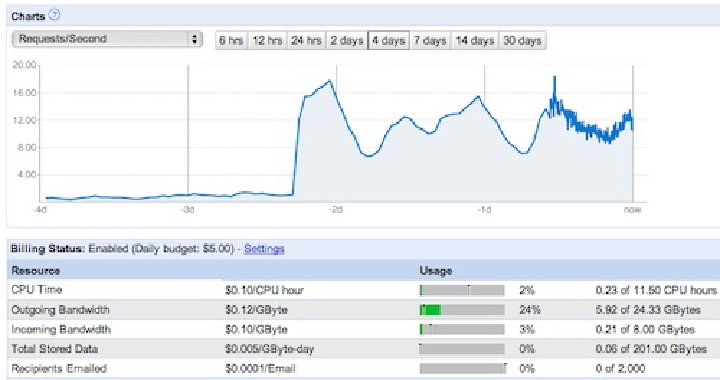
A few weeks ago I wrote about using the Google App Engine as a back end for Flower Garden. One of the comments I heard from several people is that the Google App Engine pricing scheme is “scary” due to its unpredictability. What if your server gets very busy and you find yourself with a huge bill? Google App Engine Costs At the time I wrote that post, the bandwidth of Flower Garden (and Flower Garden Free) was just under the free bandwidth allowance, so I didn’t have to pay anything. However, this last week, after riding the Pocket Frogs rocket, Flower Garden Free shot up to the #56 overall app in the US. And boy, did that make a difference in server usage! ...

October 7, 2010 · 5 min · Noel Llopis
Communicating With Players

Communicating With Players

By now every iOS developer knows that making a great game and putting it on the App Store is only part of the work. In order to get significant sales, it needs to be noticed. You need to spend a significant amount of time in marketing and PR, making sure that blogs cover it, magazines review it, or at least jump-starting it with a group of devoted and vocal forum fans. ...

September 30, 2010 · 6 min · Noel Llopis
My Standing Desk Experiment

My Standing Desk Experiment

I’m not sure where I first heard about standing desks. It was probably about a year ago in some online article, but it didn’t have much of an impact at the time. Since then, the benefits of standing (or rather, the dangers of sitting down for prolonged periods of time) has been appearing in the news more often. Some people even went as far as setting up treadmill desks! Initially I dismissed it for me because I’m reasonably active: I either run or bike 5 or 6 days per week, and the rest of the days I go for a walk around the neighborhood. It was the combination of increased studies on the effects of sitting, some people in my social circle finally making the jump and raving about it, and me developing some problems in a hamstring that finally made me consider it more seriously. And trust me, if you’re a cyclist or a runner, the last thing you want to have is hamstring problems. ...

September 24, 2010 · 7 min · Noel Llopis
Lag: The Bane Of Touch Screens

Lag: The Bane Of Touch Screens

Lag in games is as inevitable as taxes. It’s something we can try to minimize, but we always need to live with it. Earlier this week, I noticed that input for my new iPad game was very laggy. Excessively so, to the point it was really detracting from the game, so I decided I had to look into it a bit more. Lag In Games I’m defining lag as the time elapsed between the moment the player performs an input action (press a button, touch the screen, move his finger), until the game provides some feedback for that input (movement, flash behind a button, sound effect). ...

September 16, 2010 · 8 min · Noel Llopis
Google App Engine As Back End For iPhone Apps

Google App Engine As Back End For iPhone Apps

As soon as a game involves servers, there’s no such a thing anymore as “ship and forget”. Flower Garden put this in evidence about a month ago when I started getting complaints from users that the Flower Shop kept going down. Sometimes they weren’t even getting the items they were purchasing! (fortunately they can always do a free re-download, but they don’t always know that). Flower Garden was using a shared Dreamhost server to upload bouquets, host in-game news, and, most importantly, to serve the Flower Shop (which involves hosting the static shop files, redeeming promo codes, recording transactions, verifying receipts with Apple’s server, and delivering purchased content). All the Flower Shop functionality was implement in PHP and using a mySQL database. ...

September 9, 2010 · 10 min · Noel Llopis
Reconsidering Version Control

Reconsidering Version Control

Ever since I turned indie, version control just hasn’t been much of an issue. Gone are the days of hundreds of multi-GB files that changed multiple times per day. With small teams of one or two plus a few collaborators, Subversion hosted remotely worked fine. Of course, all the cool kids these days are going on about how their distributed version control systems solve world hunger, but I’ve been mostly ignoring it because I have better things to do with my time (like writing games [1]). ...

September 2, 2010 · 8 min · Noel Llopis
Growing, Indie Style

Growing, Indie Style

The media have covered to death both sides of the coin: The stories of developers striking it big, and how the great majority of indies don’t recoup their costs. A few days ago, Markus looked at indie iPhone development and how there is a middle-ground group of developers that are able to make make a living at it without going broke but without getting that big hit. Let’s call them the developer’s middle class. Markus suggested that about 20% of developers fall in that middle class, but my gut feeling, when it comes to iPhones and games, is that it’s more like 5-10%. But it’s just a made up number based on personal observation anyway. It would be very interesting to conduct some sort of survey (or analyze the App Store data), but I fear the results would get muddled up due to the differences between full time indies, hobbyists, and big companies. ...

August 26, 2010 · 5 min · Noel Llopis
Customizable Color Sections With OpenGL ES 1.1

Customizable Color Sections With OpenGL ES 1.1

One of the items in my ever-growing list of things to write about, is the rendering techniques I used in Flower Garden. In the end, it would make for a post with lots of pretty pictures, but there’s nothing particularly ground-breaking. After all, it’s all limited to OpenGL ES 1.1 on the iPhone, which means only two texture units and a two-stage texture combiner. As a result, more interesting ideas keep bubbling up to the top of the list and the poor rendering idea keeps getting passed over. ...

August 19, 2010 · 7 min · Noel Llopis
Forget Length. Give Me Awesome

Forget Length. Give Me Awesome

It pains me to see great games criticized for being too short or not having a lower price point. In a world where everything surrounding us is constantly vying for our attention, time is a premium, and filling it up with mediocre experiences, a waste. I want to have great experiences, not just long ones, and I’m willing to pay for them. Just like other media, each game has an ideal length to develop its ideas fully, and we shouldn’t fall to pressures to make then any longer than they should be. I don’t want endless grinding or backtracing through the level to meet a minimum time quota. Just like every book doesn’t have to be The Lord Of The Rings, there is room for both epic sagas like Dragon Age and Fallout and short experiences like Limbo or Braid. Maybe there’s even room for the equivalent of Italo Calvino’s shortest short story, The Dinosaur. ...

August 17, 2010 · 3 min · Noel Llopis
Prototyping: You're (Probably) Doing It Wrong

Prototyping: You're (Probably) Doing It Wrong

You’re not alone, I was also doing prototyping wrong until a few years ago. There are probably many different ways of prototyping games correctly, and maybe your way works great for you. In that case, a more accurate title for this post could have been “Prototyping: I Was Doing It Wrong”. A good game prototype is something fast/cheap that allows you to answer a specific question about your game. The key points there are fast/cheap and specific question. It’s not a level of a game, it’s not a “vertical slice”, and it’s certainly not an engine for the game. ...

August 12, 2010 · 8 min · Noel Llopis
Indie Project Management For One: Tools

Indie Project Management For One: Tools

I’ve been making computer games in some form or another for just over 25 years now. At the very beginning, as a hobby (passion) and completely by myself (although not for lack of trying to get some of my friends involved). In the late 90s, when I finally left academia and started making games professionally, teams were still relatively small, with a total of around 10-15 people per team. As we all know, budgets and scopes kept growing, and so did team sizes. At its peak, the largest team I worked at had around 200 people. That’s when I decided to go indie and started Power of Two Games, which was obviously just two of us. Finally, now as Snappy Touch, I’ve gone full circle: It’s just me again. ...

August 5, 2010 · 7 min · Noel Llopis
IAP Bundles: More Than Just Good Deals

IAP Bundles: More Than Just Good Deals

In-game point bundles are nothing new. Even before the time of in-app purchases, Zynga was famous for releasing “points” apps to increase your game reputation or other stats. The fact that they released not just one way of getting points, but many different apps at different price points, was something I dismissed as a marketing tactic to try to get noticed on the charts. Fast-forward to now, and as more companies are jumping into the bandwagon of games that need “points” to make progress, we’re still bundles. Again, I chucked that up to legacy reasons and doing what worked with the standalone apps. ...

July 29, 2010 · 4 min · Noel Llopis
Mock Objects: Friends Or Foes?

Mock Objects: Friends Or Foes?

In a previous article we covered all the details necessary to start using unit testing on a real-world project. That was enough knowledge to get started and tackle just about any codebase. Eventually you might have found yourself doing a lot of typing, writing redundant tests, or having a frustrating time interfacing with some libraries and still trying to write unit tests. Mock objects are the final piece in your toolkit that allow you to test like a pro in just about any codebase. ...

July 26, 2010 · 12 min · Noel Llopis