
I’ve gone on and on before about how much I like Objective-C and especially, how well it plays with C++. Mixing the two is a pleasure, and it’s often hard to remember where one stops and the other one starts. So much so that sometimes I catch myself calling C++ member functions like this [self myFunction:param];. Oops.
It is true that Objective-C can be a bit more verbose than plain C++, but it more than makes up for it with named parameters (which increase readability a huge amount), and not having to duplicate many things between header and implementation files.
Yet, even though I like Objective-C so much, there was one last, really annoying feature that was preventing perfect interop between C++ and Objective-C. Something so simple, yet so fundamental, that it really got in the way. Something that wouldn’t allow me to write something as simple as this:
@interface MyView : UIView
{
    // ...
    SingleTouchEvent m_singleTouchEvent;
}
SingleTouchEvent is a custom C++ class. There’s nothing wrong with that right? There shouldn’t. But if you try and compile it, you’ll get this warning:
warning: type `SingleTouchEvent' has a user-defined constructor
warning: C++ constructors and destructors will not be invoked for Objective-C fields
Some of you might be saying, no big deal, you can dynamically allocate objects and have their constructors called as usual. That’s true, but I hate allocating objects on the heap just because of something like this. My preference is always to make them member variables if I can. It’s faster, more efficient, less error prone, and easier to read. Needless to say, this was bugging the hell out of me.
I looked all over the build options in case there was some setting I could toggle to enable C++ constructors to be called, but no luck. I did a bit more research, and lo and behold, it turns out there is a custom setting you can pass directly to gcc to do exactly that! It’s nowhere in the XCode settings GUI, so you have to enter it by hand. Go to Project | Info, and in the Custom Settings section, enter the following: GCC_OBJC_CALL_CXX_CDTORS = YES
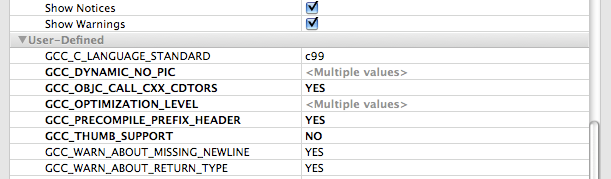
With that setting enabled, Objective-C and C++ now play together better than ever!
Without any barriers to writing new code in Objective-C, I expect it will slowly (or maybe not so slowly) replace C++ as my main language of choice for future projects.
I’ve found that using Objective C types as template parameters doesn’t work for function overloading. I think the compiler sees all objective C objects as type objc_type*. I forget the exact situation… I think it was something like…
template class RetainedPtr;
void sribbleDee(RetainedPtr labelToScribble);
void sribbleDee(RetainedPtr viewToScribble);
I’ll see if I can dig it up.
I recently had the same revelation. As of SDK 2.2.1, the option does appear in the project settings as ‘Call C++ Default Ctors/Dtors in Objective C’ – at least in the new projects I’ve created.
What code do you expect to keep in C++ versus ObjC? So far I’ve only kept matrix & vector math in C++ to take advantage of operator overloading.
I don’t suppose you know why that isn’t the default?
It seems outrageous to me that it’s not…
Great Scott! That is one handy hidden build setting! Thanks for sharing.
Thanks! This is a tremendous help for a C++ programmer trying to develop for the iPhone. (I don’t like the Objective-C syntax, so I’m using mostly C++ classes.)