Writing on the craft of making independent games, by Noel Llopis.


Dealing Cards
Most of my games and prototypes lately are very board gamey and almost always involve dealing random “cards” to create a hand of cards. For example, in Subterfuge players have the choice of one of three specialists every few hours, which is similar to dealing 3 random cards and having the player pick one. You would think that dealing cards at random would be trivially easy to implement. You would also be wrong. ...

Sometimes You Have To Let Go
As a game developer, working on a project for years just to have it cancelled can be devastating. I’ve been lucky enough that it has never happened to me, but it’s an occurrence all to common in the games industry. However, having to cancel your own game after years of work is even harder. So it is with a heavy heart that I announce that I’m stopping development on Lasting Legacy. ...

Lasting Legacy Rulebook
There’s nothing like writing down all the rules for a game to keep yourself honest. You can quickly see if complexity is spiraling out of control, and, most importantly, you get to see if your expectations of the design match the reality of the game. So I decided to write a “rulebook” for Lasting Legacy. I put rulebook in quotes because Lasting Legacy isn’t 100% a board game. There’s a light simulation component behind the scenes that is opaque to the player, but everything else can be treated like a board game. I figured it would be a good exercise for me, and maybe a good reference for early testers so they know what’s going on without a fancy tutorial. I’m happy with the final result. It’s about three pages of generously-spaced rules without any images, which beats a lot of board games out there. A word of caution: This is not trying to be a funny, engaging rulebook. It’s a dry, to the point, description of all the rules in the game, arranged in the best way to understand all the concepts in a single read. It’s also not a “How to play” document. I think that could be another interesting exercise for down the line, where I just focus on the bare minimum to get a player playing. ...

Isomorphism As a Game Design Tool
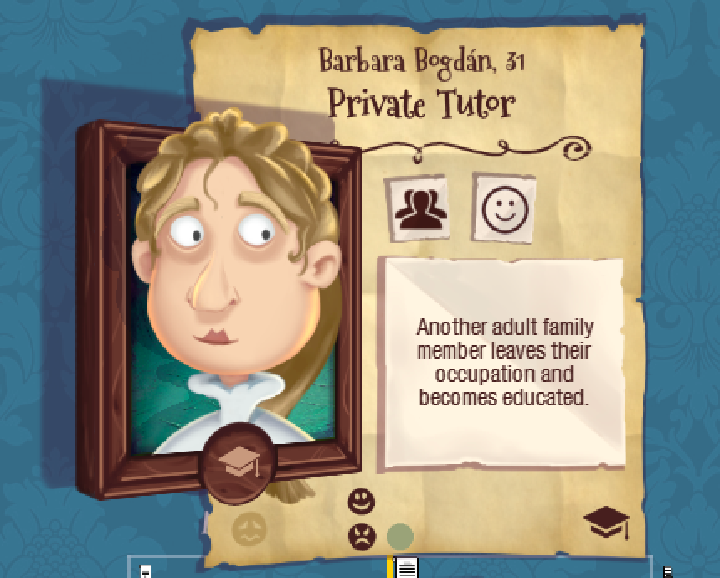
In the early stages of developing a game, once I have the idea and the feelings of the game down solid, my approach is to throw everything I can think of at the game and see what sticks. My early-in-development creative process. I don’t usually bother fleshing individual ideas out in design documents because it usually takes just as long for me to implement those things and see them in the game instead. And who would want to read about an idea when you can see how it works in the game directly? During this phase I need to generate lots of different ideas because only some of them are going to stick. The more varied the better, so I like to approach my idea generation from different angles. The two most common approaches are starting from the theme, and starting from the mechanics For example, in Lasting Legacy, we quickly came up with occupations like Family Doctor or Ball Organizer from the theme, and figured out what useful things they could do in the game (heal people, and attract new friends respectively). We also came up with several occupations starting from a mechanics point of view. For example, we knew we wanted someone to increase the income of other people, so we came up with the Savvy Businessman occupation. This time around I also used a third approach to generate ideas: Isomorphism. ...
Lasting Legacy Dev Update #3: UI Improvements
Here’s a new video showing the UI improvements and how the characters feel more alive. Apologies for the less than ideal sound and video quality. We’re working on fixing that for next time.
Using SQLite to Organize Design Data
I haven’t written purely about tech in a long time, but this is a particularly interesting intersection of tech and game design, so I thought I would share it with everybody. Be warned though: This is one of those posts that’s just about the thought process I went through for something and the solution I reached. I’m most definitely not advocating this solution for everybody. Think about it and pick the solution that works for you the best. By now you’ve probably heard of Lasting Legacy: you’re managing a family around the 19th century through several generations, socializing, choosing good marrying prospects, and helping family members pick an occupation. Ah, occupations… ...
Lasting Legacy Dev Update #2: Head of the Family and Legacy
This week’s video covers the concept of head of the family and what exactly is legacy and how to obtain it. We’re also continuing the same family as last time. Will Fanni become the heir, or will childless Peter bring the lineage to an end? I managed to keep things shorter than last time, so this one is only 12 minutes. For those of you who prefer text updates, don’t worry, we’ll have one of those next week.
Lasting Legacy Dev Update #1
Here’s the first video dev update for Lasting Legacy. We go over the basic gameplay. It’s a whopping 19 minutes long, so I may have overdone it a bit! I’ll try to keep it shorter for future updates. Since this is the first time we’re doing this, any feedback is appreciated. Would you like to see more of these in the future? What should the focus be? Any technical issues I should improve?

What Kind of Game is Lasting Legacy?
You’ve read the Lasting Legacy announcement, seen some of the art, got an idea about the setting for the game, and you even know about the feelings we want players to experience. But what kind of game is Lasting Legacy exactly? Lasting Legacy is a fairly unique game, so it doesn’t quite fit in any predetermined genre. The closest category would be single-player, turn-based simulation, although the simulation part in Lasting Legacy is very light (unlike something like Sim City or The Sims), and in that respect it’s more like a board game. So it’s more accurate to say that Lasting Legacy is a blend of simulation games and board games. Intrigued? You’re in the right place. Read on. ...

The Feelings of Lasting Legacy
When I start working on a game, one of the first things I decide is how will the game make the player feel. Different designers have different ways of driving and focusing the design of their games: some will use a short elevator pitch, some will use key pieces of art, some will let the mechanics dictate the rest. I prefer to use the way I want players to feel to anchor the design, and I flesh out the rest of the game around it. Once you have defined that feel, you can run every single design decision by it. Every game feature should support those feelings in some way, if not, they’re a good candidate to cut. And if some contradict them directly, you can veto them right away and not go down that path any further. ...

Announcing: Lasting Legacy
Today I can finally announce the game Miguel and I have been working on for a while: Lasting Legacy. You can read more about Lasting Legacy in the official web site. There isn’t a lot of information yet, but we wanted to announce it now so we can talk openly about it until release. We’ll definitely be revealing more information here over the upcoming weeks. ...

Game Development Income
Inspired by Jake Birkett’s game dev income chart, I decided to dig out my own data and make a similar chart. I figured it would be a good way to start the year looking at a retrospective of my time as an independent developer. Some interesting observations: I made zero income in my first two years as as independent developer! I was supplementing my income writing a column for Game Developer Magazine, teaching classes, and doing some contracting. I even started interviewing thinking I would have to give up the indie life and go back to work for a company. I always tell new game developers to be ready not to make any money for a while for this reason. Flower Garden seems to have a reasonable tail in spite of minimal updates. Every so often I feel a bit guilty for not doing more with it, but even if I wanted to spend time on it, I can’t think of anything that would increase sales. Subterfuge is a blip in the radar. But what’s even worse, Subterfuge took 3.5 years to make, whereas Flower Garden was around 2 years (including all updates). The US tax system isn’t really set up for people with really spikey income like this. I need to make games more quickly. Here’s to releasing a game in 2017 that is visible on that chart!
Most Influential Games (on Me)
I’ve been wanting to write about the project that I’m working on at the moment, but unfortunately we haven’t been able to announce it this year, so that will have to wait until January. I could do one of those year retrospective lists, but to be honest, I haven’t played enough digital or physical games from 2016 to be very interesting or representative. Instead, I’m going to try something a bit different. I want to highlight the games that have had the most influence on me as a game maker. Not the best games, not the most memorable games, not the most impressive games, but the ones that have directly influenced me and the games I’ve made. ...

Best Board Games of 2015
My tastes in board games are always evolving and changing, and 2015 was a very different year that marked a turning point for me. Looking at my play statistics, it’s clear that something changed: I played fewer games than in previous years, and, most importantly, I played many fewer new games than other years. 2015 was the year when I started focusing on playing more often the games I loved, and stopped chasing after trying all the hot new games. Towards the end of 2014 it dawned on me that most new board games I was playing were ranging from bad to just OK, and only a selected few made it into the good or very good category. So why was I spending so much time and energy playing new games? It’s not like I had played the old ones too much and was done with them. As a matter of fact, I was frustrated with how little I was playing them, and how, if I only play a game once every six months or a year, I’m basically starting over from scratch. So I was always playing games at a very superficial level, without being able to get deeper into them. Not to mention it’s a pleasure to pull out a game and not have to worry about reading or explaining the rules! 2015 was the year of depth for me. Of course depth comes at the cost of breath, so when it comes time to make a best-of list for 2015, I don’t have nearly as many different games to draw on as other years. Because of that, I’ll limit my list to just 3 games. ...
State of the Blog
When was the last time I wrote something in this blog? It was a while ago. Hmm… Let me check. Yikes! It was over a year ago! That’s probably the longest gap ever in the history of this blog. What happened? And most importantly for the two of you still reading, what’s going to happen over here? ...